Optimizing AWS Serverless Migration: Key Steps and Challenges
AWS serverless technologies have revolutionized how organizations build and run applications. By abstracting away the underlying infrastructure, serverless allows businesses to focus purely on innovation, leading to faster development cycles, reduced operational costs, and unparalleled scalability. In 2026, as cloud adoption matures, migrating to a serverless architecture on AWS isn’t just an option; it’s a strategic imperative for staying competitive. But how do you navigate this transformation effectively? This guide from Sita Infobytes outlines the key steps and common challenges in optimizing your AWS serverless migration.
Why Go Serverless with AWS? The Undeniable Benefits
The allure of serverless isn’t just hype; it delivers tangible benefits that resonate deeply with modern business objectives, especially when leveraging AWS’s robust ecosystem of services like AWS Lambda, Amazon API Gateway, DynamoDB, and S3. Here’s why organizations are increasingly embracing this paradigm:
- Unmatched Scalability: Serverless applications automatically scale with demand, handling anything from zero requests to millions without manual intervention. You pay only for the compute time consumed, making it incredibly elastic.
- Superior Cost Efficiency: With a pay-per-execution model, you eliminate idle capacity costs. AWS takes care of server provisioning and maintenance, significantly reducing operational expenditure.
- Reduced Operational Overhead: Say goodbye to server patching, OS updates, and infrastructure management. AWS handles all the heavy lifting, freeing your engineering teams to focus on core business logic.
- Faster Innovation & Time-to-Market: Developers can deploy code more frequently and rapidly, experimenting with new features and services without the friction of infrastructure concerns.
- Enhanced Reliability: AWS serverless services are inherently highly available and fault-tolerant, built on AWS’s global infrastructure.
Key Steps for a Successful AWS Serverless Migration
A well-planned migration is crucial for success. Here are the fundamental steps to guide your journey:
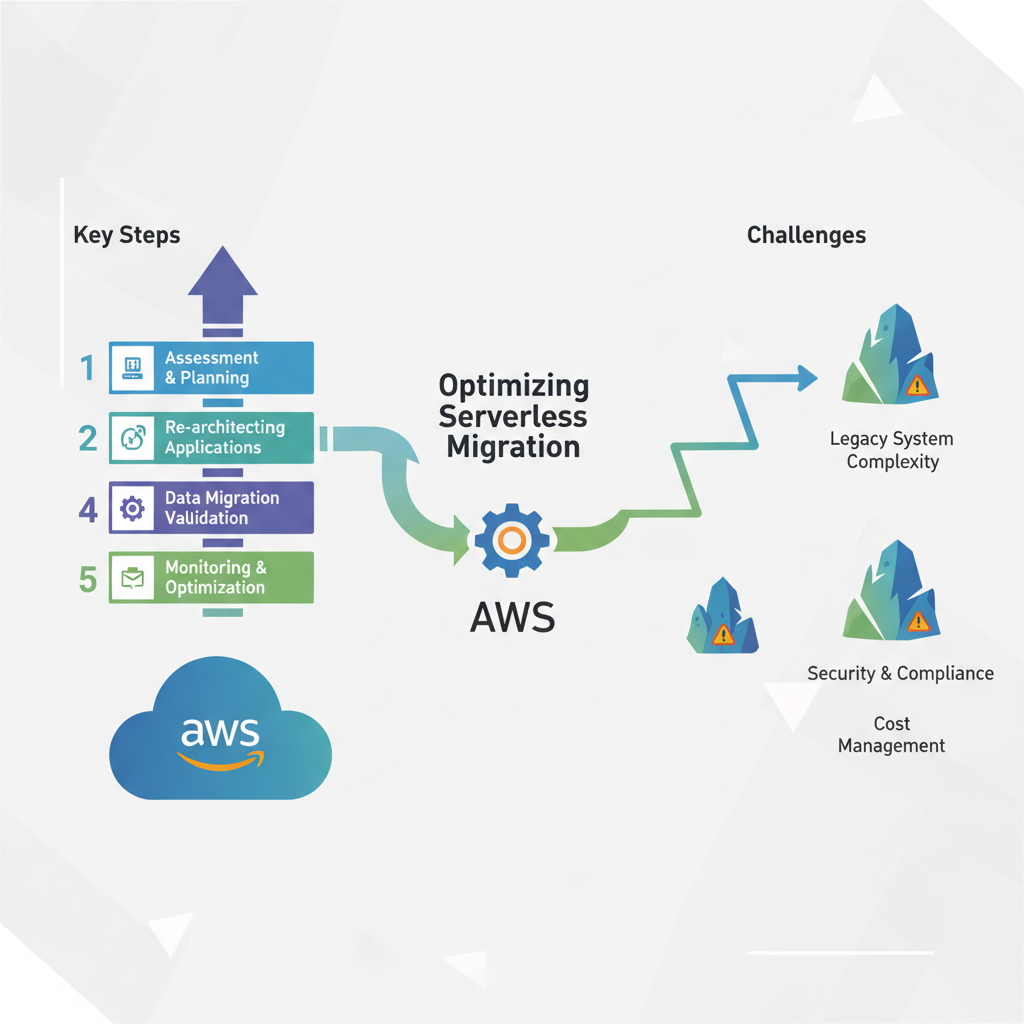
1. Comprehensive Assessment and Planning
Before writing a single line of serverless code, conduct a thorough analysis of your existing applications. Identify which applications are good candidates for serverless (e.g., event-driven, microservices-oriented, web APIs). Create a detailed migration roadmap, defining scope, timelines, resource allocation, and success metrics. Prioritize applications based on business value, complexity, and dependencies. Don’t forget to build a strong business case, outlining expected ROI from cost savings and agility gains.
2. Application Refactoring and Re-platforming
Many legacy applications aren’t directly compatible with a serverless paradigm. This step often involves refactoring monolithic applications into smaller, independent microservices or functions (FaaS – Function as a Service, like AWS Lambda). Design your architecture to be event-driven, leveraging services like Amazon SQS, SNS, and EventBridge to facilitate communication between components. Focus on statelessness and independent deployment units.
3. Robust Data Migration Strategy
Data migration is often the most complex part of any cloud journey. For serverless, this means selecting appropriate databases (e.g., Amazon DynamoDB for NoSQL, Amazon Aurora Serverless for relational workloads) and strategizing how to move your existing data securely and with minimal downtime. Consider tools like AWS DMS (Database Migration Service) and plan for data validation and synchronization.
4. Automate Deployment and Operations
Serverless thrives on automation. Implement a robust Continuous Integration/Continuous Deployment (CI/CD) pipeline using services like AWS CodePipeline, CodeBuild, and CodeDeploy, or third-party tools. Infrastructure as Code (IaC) with AWS CloudFormation or AWS SAM (Serverless Application Model) is essential for defining, provisioning, and managing your serverless resources consistently and repeatably. This minimizes manual errors and speeds up deployments.
5. Continuous Monitoring and Optimization
Post-migration, active monitoring is paramount. Utilize AWS CloudWatch, X-Ray, and other observability tools to gain deep insights into the performance, errors, and cost of your serverless functions and services. Continuously optimize your Lambda functions for memory, CPU, and cold start times. Implement cost optimization strategies, such as rightsizing Lambda memory, leveraging Graviton processors, and optimizing database usage. This is where you truly realize the benefits of AWS compute optimization.
Navigating the Roadblocks: Common Challenges and Solutions
While the benefits are compelling, migrating to serverless isn’t without its hurdles. Being aware of these challenges and having strategies to overcome them is key:
1. Taming Legacy Code and Monoliths
Challenge: Breaking down tightly coupled monolithic applications into independent, stateless functions can be daunting. Legacy codebases might not be designed for the event-driven, distributed nature of serverless. This is a common cloud adoption challenge.
Solution: Adopt a strangler fig pattern, gradually peeling off functionalities into new serverless components while the monolith continues to operate. Start with less critical, easily isolatable services. Invest in refactoring and re-architecting efforts, focusing on domain-driven design.
2. Addressing Security and Compliance Concerns
Challenge: In a serverless world, security shifts from securing servers to securing functions, APIs, and data access. Misconfigurations can lead to vulnerabilities.
Solution: Implement the principle of least privilege for IAM roles associated with Lambda functions. Use AWS WAF for API Gateway, manage secrets securely with AWS Secrets Manager, and leverage security services like Amazon GuardDuty and Security Hub. Ensure compliance frameworks (e.g., GDPR, HIPAA) are integrated into your serverless design from the outset.
3. Mastering Cost Management
Challenge: While serverless can be cost-effective, misconfigured functions or inefficient designs can lead to unexpected bills, especially with high invocation counts or excessive memory allocation.
Solution: Regularly monitor costs using AWS Cost Explorer and configure budget alerts. Optimize Lambda function memory and runtime, identify and eliminate unused resources, and leverage provisioned concurrency for critical, high-traffic functions to reduce cold starts and potential costs.
4. Bridging Skill Gaps
Challenge: Your existing team might be more accustomed to traditional server management, and the serverless paradigm requires new skills in distributed systems, event-driven architectures, and specific AWS services.
Solution: Invest in training and upskilling programs for your engineering teams. Foster a culture of learning and experimentation. Consider partnering with expert cloud consulting firms like Sita Infobytes to augment your team’s capabilities during the transition.
5. Debugging and Observability in Distributed Systems
Challenge: Debugging across multiple independent functions and services can be more complex than in a monolithic environment. Tracing requests and understanding system behavior across distributed components requires new tools and approaches.
Solution: Implement robust logging with AWS CloudWatch Logs, distributed tracing with AWS X-Ray, and metrics collection. Centralize logs and metrics for easier analysis. Develop strong observability practices from the start to quickly identify and resolve issues.
Beyond Migration: Optimizing Your Serverless Landscape
Migration is just the beginning. Continuous optimization is key to maximizing the benefits of your AWS serverless environment. Regularly review your architecture for potential improvements, explore new AWS services, and refine your CI/CD pipelines. Focus on performance tuning, cost efficiency, and maintaining a strong security posture. Embracing a culture of continuous improvement will ensure your serverless applications remain agile, resilient, and cost-effective for years to come.
Ready to Accelerate Your Serverless Journey?
Navigating the complexities of AWS serverless migration requires deep expertise and a strategic approach. At Sita Infobytes, we specialize in helping businesses like yours harness the full potential of AWS serverless technologies, from initial assessment and planning to seamless migration and ongoing optimization. If you’re looking to transform your infrastructure and accelerate innovation, don’t hesitate to reach out.
Connect with our experts and discover how our specialized cloud migration and serverless solutions can empower your business. Visit our Contact Us page today to discuss your specific needs and avail our blog category services in cloud migration and serverless solutions.