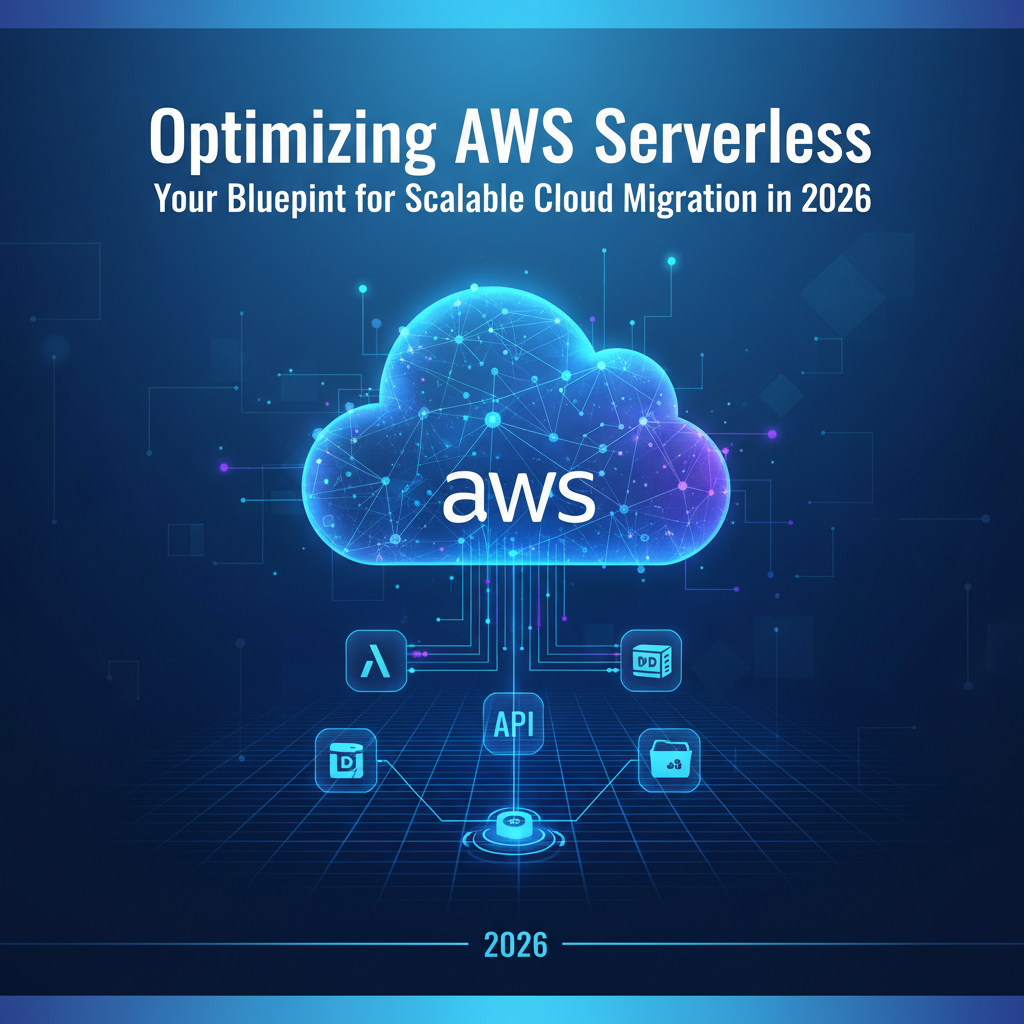
Optimizing AWS Serverless: Your Blueprint for Scalable Cloud Migration in 2026
In 2026, the imperative for businesses to migrate to the cloud isn’t just about presence; it’s about performance, agility, and scalability. As organizations look to modernize their operations and unlock true digital transformation, AWS serverless architectures have emerged as a game-changer for achieving highly scalable and efficient cloud migrations. At Sita Infobytes, we believe that understanding and optimizing these architectures is key to a successful, future-proof cloud journey.
Why Serverless on AWS for Cloud Migration?
Migrating legacy systems or building new applications in the cloud can be complex. Serverless, particularly on AWS, simplifies much of this complexity by abstracting away server management. Here’s why it’s a powerful ally for scalable cloud adoption:
- Automatic Scalability: AWS serverless services, like Lambda and DynamoDB, automatically scale to meet demand, eliminating the need for manual provisioning or over-provisioning. This means your applications can handle sudden spikes in traffic without performance degradation.
- Cost Efficiency: With a pay-per-use model, you only pay for the compute time and resources your code consumes. There are no idle servers costing you money, leading to significant AWS compute optimization and overall cost savings.
- Reduced Operational Overhead: AWS manages the underlying infrastructure, operating systems, and security patches. This frees your engineering teams from undifferentiated heavy lifting, allowing them to focus on innovation and core business logic.
- Accelerated Innovation: Faster development cycles are a hallmark of serverless. Developers can deploy code more rapidly, iterate quickly, and bring new features to market at an unprecedented pace.
Core Strategies for a Seamless Serverless Migration
While serverless offers immense benefits, a successful migration requires strategic planning and execution. Here are key strategies for optimizing your AWS serverless migration:
1. Adopt a Phased, Microservices Approach
Instead of a ‘big bang’ migration, break down monolithic applications into smaller, independent microservices. Start by identifying less critical components or new functionalities that can be built or migrated as serverless functions. This allows for iterative learning and reduces risk.
2. Master AWS Serverless Services
Familiarize your team with the core AWS serverless ecosystem:
- AWS Lambda: For running code without provisioning or managing servers.
- Amazon API Gateway: To create, publish, maintain, monitor, and secure APIs for your Lambda functions.
- Amazon DynamoDB: A fast and flexible NoSQL database service for all applications that need consistent, single-digit-millisecond latency at any scale.
- Amazon SQS & SNS: For message queuing and notification services to build decoupled architectures.
- AWS Step Functions: For orchestrating complex workflows involving multiple Lambda functions.
- Amazon EventBridge: For building event-driven architectures, connecting applications using events from your own apps, SaaS apps, and AWS services.
3. Prioritize Cost Optimization from Day One
While serverless is inherently cost-efficient, continuous optimization is crucial. Monitor Lambda execution times, memory usage, and function invocations. Right-size your Lambda functions, utilize reserved concurrency where appropriate, and analyze your DynamoDB read/write capacities to align with actual usage patterns.
4. Implement Robust Security Measures
Security is paramount. Leverage AWS Identity and Access Management (IAM) to apply the principle of least privilege. Configure VPCs for network isolation, use AWS WAF for API protection, and ensure proper encryption for data at rest and in transit. Regular security audits are non-negotiable.
5. Embrace Monitoring and Observability
Serverless distributed systems require comprehensive monitoring. Use Amazon CloudWatch for logs, metrics, and alarms. AWS X-Ray provides end-to-end visibility into requests as they travel through your serverless applications, helping you identify performance bottlenecks and errors quickly.
6. Automate with Infrastructure as Code (IaC)
Tools like AWS CloudFormation, AWS Serverless Application Model (SAM), or AWS CDK are essential for defining and deploying your serverless infrastructure consistently and repeatably. IaC reduces manual errors, speeds up deployments, and enables version control for your infrastructure.
7. Plan Your Data Migration Carefully
Data migration is often the most complex part of any cloud journey. For serverless, consider services like AWS Database Migration Service (DMS) for relational databases, or direct data uploads to S3 or DynamoDB for suitable datasets. Plan for data transformation, validation, and synchronization to minimize downtime.
The Future is Serverless: Benefits Beyond Migration in 2026
Beyond the initial migration, optimized AWS serverless architectures position your business for future growth. In 2026, this means enhanced readiness for integrating advanced AI/ML capabilities, supporting edge computing scenarios, and fostering an environment of continuous innovation. Your development teams will be more productive, leading to quicker feature releases and a more competitive edge.
Ready to Optimize Your Cloud Journey?
Navigating the complexities of AWS serverless migration and optimization requires specialized expertise. At Sita Infobytes, we partner with businesses like yours to design, implement, and optimize scalable cloud solutions that drive tangible results.
Don’t let cloud migration challenges hold you back. Reach out to us today to explore how our expert services can accelerate your journey to a fully optimized, scalable serverless future. Visit our Contact Us page to get started!